brand engineering
how to command perception at scale


Thank you to Oscar Dumlao and Anshu Mohan for their insightful feedback.
As we approach takeoff across all industries, everything will become a commodity.
With information processing, retrieval, and coordination cheapening exponentially, we move into a new paradigm where the human touch is premium.
Humans will command value through their organizational and individual brands which determine, in Silicon Valley at least:
How much capital can you raise?
Who do you have a right to recruit?
What is your revenue quality?
What competition can you eliminate, or better yet, get to join your org instead?
If it’s now commoditization all the way down, brand engineering will answer these questions.
Brand engineering is the active practice of building the engine that controls how you and your organization show up in the world.
It is the systematic cultivation of trust, narrative, and credibility to command perception at scale.
How is brand engineering different from traditional branding?
The concept of brand engineering has been briefly written about previously, but I argue its scope and significance are far more important than anyone has understood, communicated, or created a playbook for to date. This is also not the same as “having taste,” as the zeitgeist likes to espouse; taste is receptive discernment rather than proactive execution.
PR used to have a stranglehold on large outlets, and therefore public perception. Save for historical aggressors like Robert Moses who broke news personally to control his multitude of narratives. The power of great individuals and their companies largely relied on borrowing the power of those who command trust (PR) because they could not own their own channels, because no one cared about a company’s standalone presence, because, in the earlier years, there was no online way to even build one’s presence.
To craft the narrative environment needed for your brand, you will need to manage an online presence, both for yourself and your organization. It is dangerous to let the narrative environment itself shape what you are capable of doing. Brand engineering involves figuring out the tactics of narrative control. There is no singular “right” way to do this, only more or less appropriate frames to show up in depending on what your goals or organizational realities are.
For instance many of the AI coding startups, at the start, were a bunch of awesome engineers who didn’t focus on brand understanding. They benefited from high frequency evangelism from their engineers on X, positioning themselves as scrappy, earnest builders trying to figure out this whole AI thing with the community. The outcome is they are perceived as commendable underdogs. In how they show up in the tech world or X sphere, this yielded a wonderful benefit: everyone was rooting for their success and was forgiving of their failures.
Now AI coding startups are scaling enterprise deals and need to surmount the credibility of direct offerings from labs. The old narrative isn’t the best fit for this goal anymore, so they must change the control levers they pull and hire brand engineers as they move from individual branding to leveraging an organizational mouthpiece. This shift is especially critical for companies that can commoditize their compliments via branding.
We could go into many case studies of how brand engineering aperture should shift as a company scales, but instead let’s look at the two buckets.
Commodity Organization
Commodity businesses require human trust to win customers. Some trust has become commoditized as lead gen ease scaled (people trust top of funnel “brands” like AI martech platforms, referral networks, etc). One could just acquire a commodity brand and scale from there, but that’s a conversation for another piece, given the complexity of roll-ups. Or, these companies could rely on VC king-making to show dollar acceleration in their space, boxing out competitors to make them think there’s not room to play in their commodity space.
Take Chapter as an example. They partner with hospital systems to grow on other organizations’ balance sheets, lowering their CAC via borrowing brand credibility. They had to accept that they are in a commodity space that no one wants to talk about (when was the last time you discussed insurance over drinks?) and so also build personal goodwill via senior influencers and straight up just best-in-class execution (they only have ~1 ops person which is unheard of for this kind of business). This sort of scaled human touch helps them command loyalty (crucial to commodity businesses), leading to Chapter’s incredibly low churn.
Commodity Individual
I believe no individual is unique, so to survive AI commodification, all people must build brands for themselves. Touchpoint velocity with your audience is most important as they could go anywhere for what you have to offer. This commoditization of individuals has already begun, as we started consuming more content from individuals rather than just organization accounts (most traditional) or the founders themselves. The study of how to strategically and artificially develop individual brands at an organization, and orchestrate them when needed (ex: I’ll ghostwrite each employee’s posts as part of a launch) is one example of how an individual online brand may be engineered.
Online isn’t the only nor per se best way to build a brand, as successful or spikey individuals can still be “in your face” offline from folks continually bringing them up in organic conversations. Such as stars like Cobi Blumenfeld-Gantz, founder of Chapter, who spent 6 years building a track record at Palantir that results in former colleagues calling him “incredibly intense.”
I believe engineering brands, at a high level, is important for anyone and any org. You have to ask yourself how much of a commodity the brand you’re trying to build is. I did not say ask how much of a commodity the product you’re trying to build is. Brands themselves can be the product, just as evals will be the product, eventually.
Each of these markets does have compression in the long tail, as the top brand will win, but some examples of brand-based moats:
Aggregators – ex. recommendation marketplaces
Brokers – shoutout Chapter
Defense – need personal brand with gov folks
Robotics application layer – or other nascent industries that need explaining
Lawyers – due to CYA
*By the way, I think the above company shapes are interesting startup pursuits. Reach out if you’re building in one of them :)
Brand Engineers (The Job)
As a founder hires, they delegate ownership of key responsibilities to early roles. The stack of “founding [X]” roles is always changing. We know there are founding engineers — people who confidently own building the first product. Last year, the important hire might have been the founding designer (or design engineer), who owned making early bets coherent and delightful. I now assert that an important role is the brand engineer, who owns how your company — it as an entity, its employees, its positioning, its culture — shows up in the world. Hiring brand engineers allows founders to scale personally and organizationally, even if often the best brand engineer at a company is the founder themselves.
I define the individual brand engineer as: “A social person who executes the vision of what the company is, why it exists, and how it shows up.”
I predict this role’s growth to be similar to the rise of the design engineer function, which first emerged as a concept in 2020, or Agent PMs, which was coined recently and is rapidly growing.
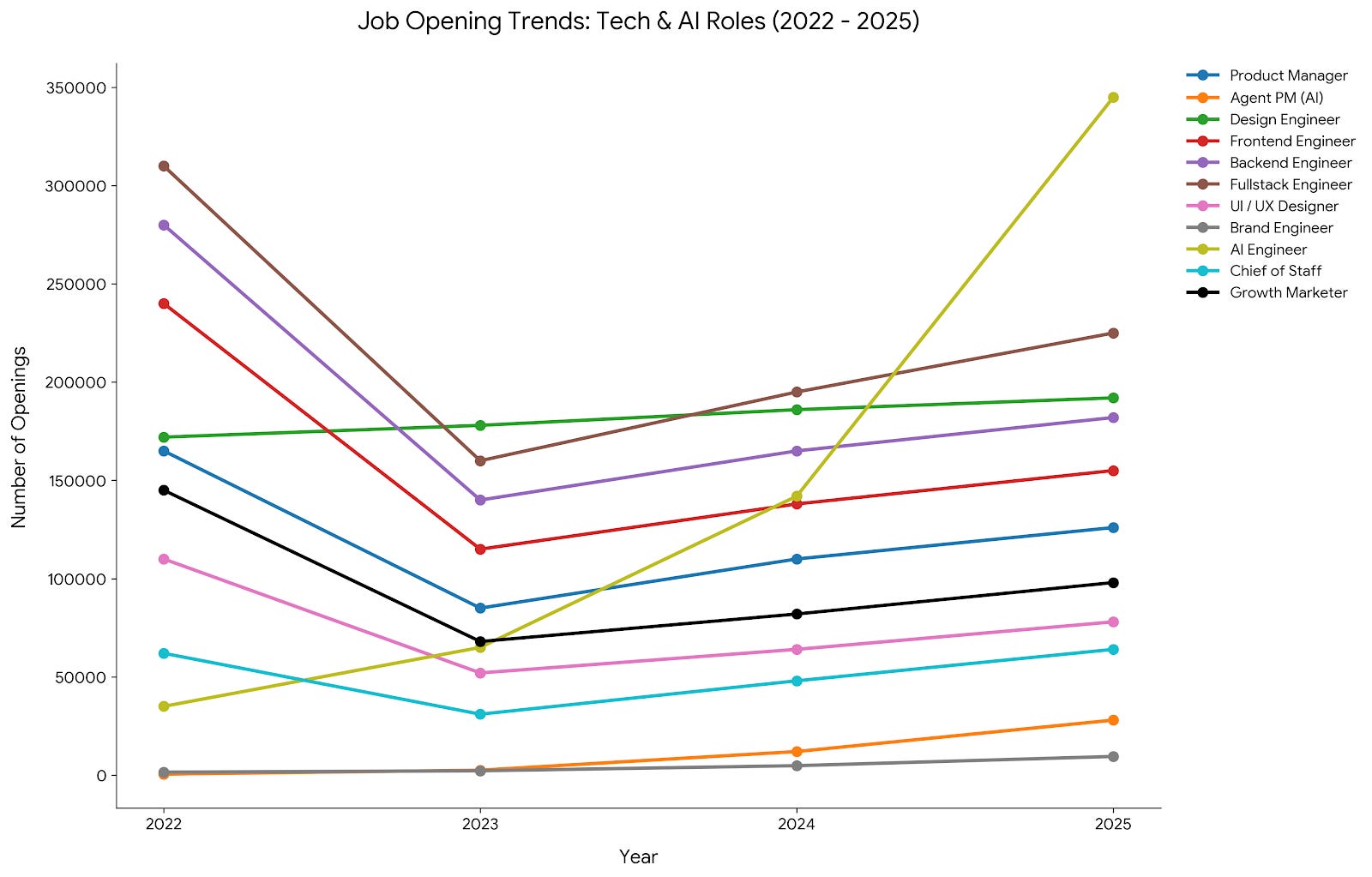
*This graph was made with Claude, so take it with a giant grain of salt.
Outstanding questions
Some key questions I have for the future of brand engineering, which I won’t expand my thoughts on here but do welcome others’ answers to are:
Just as there are specialist PMs (consumer, growth, business, platform, research), there will be specialist brand engineers. What are these archetypes?
What aspects of online brand engineering can one automate with a GTM developer?
Does online branding become useless if agents run the internet and humans don’t look at it, so in person becomes the only alpha?
How does one engineer a brand for agent attention?
If you resonate with the concept of brand engineers, or feel that this may be the role you’ve been looking for – please reach out! This concept resulted from conversations with my portcos and realizing this is the new sort of hire they need, so I have some awesome companies that would love to meet you.
Love this Katie